|
International
Law at the Vanishing Point
Richard Falk and
Aslı Ü. Bâli
Richard Falk,
professor emeritus of international law and practice at Princeton
University, is a visiting professor at the University of
California-Santa Barbara. Aslı Ü. Bâli is the Irving S. Ribicoff
Fellow at Yale Law School.
|

The bridge over Wadi Gaza remains impassable for
motorists seeking to use Gaza’s coastal road. Israeli aircraft
blew out the bridge in June 2006. (George
Azar) |
In the summer of 2006,
two border incidents were invoked by Israel, with strong US
diplomatic support and material assistance, to justify a prolonged
military offensive in Gaza and a crushing “shock and awe” assault on
Lebanon. The main international response, effectively orchestrated
by Washington, was built around the bland assertion that Israel has
the “right to defend itself.”
Of course, it does.
But in the summer the unasked questions were “how,” “with what
limits” and “by what means”? It is the role of international law to
provide answers to such questions, sometimes not very precise
answers, but at least guidelines, which commanders and sovereign
governments have considerable latitude to interpret with reference
to considerations of “military necessity.” What this means in
practice is a rather broad margin of discretion in the international
law of war that makes unlawful only clearly outrageous and
unreasonable behavior, whether by states or by non-state actors
engaged in armed struggle.
In the case of
Israel’s summertime conflicts on its southern and northern borders,
the international community, again led by Washington, swiftly
condemned the actions of Israel’s “extremist” adversaries, and
acquiesced in the tightening of existing sanctions upon them by
legal and other means. Yet although Israel’s actions in both Gaza
and Lebanon were plainly unlawful by international legal standards,
there was less condemnation and no material sanction imposed upon
Israel, least of all by the chief arbiter of international peace and
security, the UN Security Council. The imbalance in the
international response has gravely undermined the credibility and,
ultimately, the enforceability of international legal norms, which
are only norms to the degree that they are enforced without fear or
favor.
Lawful Limits of
Self-Defense
On June 25, 2006,
fighters belonging to three Palestinian factions, including Hamas,
tunneled under the fence separating the Gaza Strip from Israel at
the Kerem Shalom border crossing and attacked the army post on the
Israeli side. The Palestinians killed two soldiers and snatched a
third, whom they spirited back into Gaza, where he presumably
remains captive. In an announced attempt to retrieve the soldier,
Israel has bombed bridges and a power plant in Gaza, stepped up
artillery and aerial bombardment of sites believed to house the
ineffective rocketeers of Hamas, launched multiple tank incursions
into Gaza, arrested tens of Hamas parliamentarians without charge
and locked down the sole point of transit for people and goods
between Gaza and the outside world. According to the UN, over 300
Palestinians have been killed in the ongoing Israeli offensive.
Global media attention
shifted northward on July 12, when Hizballah militants crossed into
undisputed Israeli territory, killing three Israeli soldiers and
abducting two others, with five additional soldiers being killed on
Lebanese territory in the course of an attempted rescue operation.
In the ensuing month-long war, Israel bombed bridges, roads, power
plants and other civilian infrastructure in Lebanon, and conducted
multiple strikes on Beirut neighborhoods and southern villages it
dubbed “Hizballah strongholds.” Israel also imposed a comprehensive
land, sea and air blockade upon Lebanon. Upwards of 1,000 Lebanese
were killed, and nearly one million displaced, in the course of the
bombardment, while 39 Israeli civilians were killed, and hundreds of
thousands compelled to flee their homes, by Hizballah’s retaliatory
rocket fire. The UN Security Council brokered a “cessation of
hostilities” between Israel and Hizballah in mid-August, but not
between Israel and the fighters in Gaza, where a low-level war
continues to rage.
Against the background
of these events, a nasty mind game emerged: Israel’s right to defend
itself was improperly merged with Israel’s supposed right to act in
“self-defense” as generally understood in international law. The
trouble here was that the UN Charter and international law have
restricted valid claims of self-defense to situations where a major
“armed attack” has occurred, precisely to avoid authorizing wars or
excessive force as legal responses to border incidents. Indeed, the
World Court found US claims of collective self-defense unlawful in
the important 1986 case of Nicaragua v. the United States, on
the grounds that Nicaraguan assistance to the armed insurgency in El
Salvador fell short of an “armed attack.” Understood in this
context, Israel’s claimed right to large-scale attacks on Gaza and
Lebanon in response to border skirmishes involving the capture of
three soldiers is certainly invalid under the international law of
self-defense.
But there is a second
layer of concern. It is assumed in diplomatic discourse and the
media that once Israel invokes its right of self-defense, then
anything goes. This negates the role of the law of war and
international humanitarian law, the function of which is to set
limits and provide guidelines for belligerents in wartime
situations. That is, even if Israel had a valid basis for declaring
war on Lebanon, its conduct of that war would have to be constrained
by the requirements of the laws of war.
|

Firefighter in a house damaged by a Hizballah rocket in
Kiryat Shimona, July 23, 2006. (Nir
Kafri) |
More than
international law is at stake here. To validate the Israeli
responses to the Palestinian and Hizballah raids is to defy the rule
of reason, which underpins world order and international law in
crucial respects. It takes only a modest imagination to envision
regions in flames if incidents of this, or even greater magnitude,
were to be seized upon by the targeted country as occasions for
general war.
If, then, Israel has a
legal right to defend itself, but not a right of self-defense to
justify acts of war, what was it entitled to do? A truly
satisfactory answer to this question requires a consideration of the
context, including the degree to which the Palestinian and Hizballah
raids were unprovoked rather than being part of a prolonged series
of border incidents. But leaving aside context, Israel’s right to
defend itself clearly encompassed steps, including border crossing,
to catch and punish the perpetrators, and quite possibly to destroy
their immediate base of operations. As Israel exceeded these
measures within a day in both Gaza and Lebanon, the actual Israeli
responses to the raids were grossly excessive, even if Israel is
given the benefit of every doubt, by excluding context.
Mind games also
emerged surrounding the proper body of applicable law. Israel has
always maintained that Articles 47-78 of the Fourth Geneva
Convention, laying out the duties of an occupying power, do not
apply to its actions in the territories taken in the 1967 war.
Though Israel is alone in this interpretation, it considers its
legal argument greatly strengthened, with regard to Gaza, following
its summer 2005 withdrawal of settlers and soldiers from the strip.
Further, it is Israel’s claim that in both Gaza and Lebanon its
enemy is not a state, but a non-state actor who is not a party to
the four Geneva Conventions that constitute the body of
international humanitarian law (IHL).
The First Geneva
Protocol on the Protection of Victims of International Armed
Conflict (1977) supplements IHL by extending legal coverage to
conflicts between a state and a non-state actor. Israel has not
signed this widely ratified treaty, and so is not directly bound by
it. But here also most of these obligations are now regarded as
customary international law, which, like IHL itself, binds a state
whether or not it has accepted a particular treaty. The 1977
protocol also binds non-state entities such as Hamas and Hizballah
whenever they become participants in international conflicts.
Therefore, if the conflicts are understood as being between Israel
and Hamas on one front, and Israel and Hizballah on the other, then
both sides in both settings are bound at least by IHL recognized as
customary.
Israel also insisted
that the failure of Lebanon, as distinct from Hizballah, to deploy
its army against the Israeli attack confirmed its claim that the
Geneva Conventions were not applicable. This line of argument is
contrary to international law as embodied in Common Article 3
of these treaties, which declares that the conventions shall apply
in “any armed conflict…even if the state of war is not recognized by
one of them,” and that parties to the conventions remain bound “even
if the…occupation meets with no armed resistance.”
The behavior of the
various parties is all subject to customary international law of war
(CILW), which has evolved over the centuries from its origins in the
just war tradition, and has long been a recognized part of
international law alongside treaties and conventions. There are four
principles of CILW: the principle of proportionality, by which a
legally valid military response must be proportional to the
provoking occasion; the principle of necessity, by which a legally
valid use of force must be necessary to achieve a lawful goal; the
principle of discrimination, by which a legally valid use of force
must discriminate between military and civilian targets; and the
principle of humanity, by which a legally valid use of force must
not rely on tactics that are cruel or widely perceived as inhumane.
Obviously, these principles offer only very general guidelines that
must be adjudged in specific circumstances, and whose proper
application depends on a judicious application of the rule of
reason.
The Gaza Offensive
Since its 2005
“disengagement” from Gaza, Israel has retained complete border
control, including rigid regulation of entry and exit from the
strip, and control over Gazan airspace and offshore waters. It has
also mounted frequent armed incursions into Gaza and launched air
strikes at will. Given these realities, it would seem appropriate to
consider Gaza as still subject to Israeli occupation until a
withdrawal occurs that is fully respectful of Gaza’s
autonomy.
This conclusion bears
upon the legal treatment of the border incident that Israel relied
upon to launch its sustained Gaza offensive. The narrow legal issue
is whether the Kerem Shalom raid was an act of terrorism or not.
There is a strong basis in international law for affirming a
Palestinian right of resistance, given the prolonged occupation by
Israel, the refusal by Israel to respect UN resolutions calling for
withdrawal to the 1967 borders, and Israel’s persistent violation of
IHL inflicting great hardship on the Palestinians subject to the
occupation.[1] Such a right of resistance does not accord
impunity to Palestinian militants who use violence directly against
Israeli civilian targets, of course. Such methods of resistance are
criminal violations of the law of war. Since the targets on June 28
were military personnel, this incident does not qualify as an act of
terrorism or a violation of the law of war.
At the same time, it
is a violation of IHL and CILW to use the abducted Israeli soldier
as a “bargaining chip,” held illegally as a “hostage” for the sake
of negotiating a prisoner release, especially if combined with a
threat to his life. The severity of this violation by the
Palestinian militant groups is somewhat diminished by their
reiterated willingness to negotiate his release, the refusal of
Israel to engage in diplomatic discussion with elected Palestinian
leaders and the fact that Israel has itself frequently abducted
Palestinians whom it continues to detain without charge.
The big legal issue
arises from the disproportion, excessiveness and indiscriminate
character of the Gaza offensive. Even if the Israeli interpretation
of the abduction incident is fully accepted, there is scant legal
justification for the Israeli response, either from the perspective
of Common Article 3 of the Geneva Conventions requiring respect
for the sanctity of civilian life or by the wider standards of CILW.
There are two relevant norms set forth in the Hague Conventions that
provide a basic standard against which to judge belligerents. First,
Article 22 of Hague Convention IV on Land Warfare states that
“the right of belligerents to adopt means of injuring the enemy is
not unlimited.” This norm incorporates a measure of proportionality
between the scale of provocation and response that was clearly
absent from Israeli actions. Second, the so-called Martens clause in
the preamble of the Hague Convention declares that “[u]ntil a more
complete code of the laws of war has been issued…the inhabitants and
belligerents remain under the protection and the rule of the
principles of the law of nations, as they result from the usages
established among civilized peoples, from the laws of humanity, and
the dictates of public conscience.” On this basis, responding to the
following questions provides a legal assessment until, if ever, a
duly constituted tribunal assesses the situation: Was the Gaza
offensive a reasonable response, given the surrounding
circumstances? Did its particular uses of force violate the limits
imposed by IHL and CILW? The logical assessment is that it was
unreasonable with respect to scale, scope, duration and impact on
the civilian population of Gaza, as well as with respect to targets
and methods.
Such an assessment is
reinforced by several other considerations. Treating the Kerem
Shalom incident as “the cause” of Israel’s offensive ignores prior
and frequent Israeli provocations in the form of unlawful uses of
force in Gaza. For instance, on June 9, 2006, Israel fired artillery
shells that struck Palestinian civilians on the beach, killing eight
and wounding 32; on June 13, Israeli aircraft fired missiles at an
ordinary van, in a supposed targeted assassination of a Hamas
leader, killing nine Palestinian civilians; on June 20, in another
assassination attempt that misfired, three Palestinian children were
killed and 15 wounded. Even aside from the civilian casualties,
these Israeli tactics are violations of Article 10 of the
Universal Declaration of Human Rights that categorically prohibits
extrajudicial executions and punishments. Moreover, with the Gazan
population already beleaguered by denial of humanitarian foreign
assistance for several months, the offensive is most convincingly
regarded as an extreme form of collective punishment endangering
civilian health and life. Article 33 of Geneva IV categorically
prohibits collective punishments inflicted on civilians under
occupation. The conclusion that Israel knowingly engaged in
collective punishment is strongly reinforced by the deliberate
bombardment of Gaza’s only power plant, which provided an estimated
60 percent of Gaza’s electricity and was crucial for the maintenance
of the water purification system. Surely, this strike was a
flagrantly unlawful act of war that could also be considered a crime
against humanity.
The Attack on
Lebanon
|
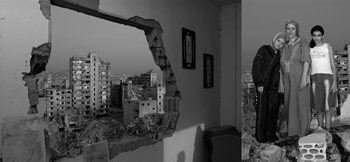
Sausan Qasim and her daughters stand on what is left of
the terrace of their apartment in Haret Hreik, August 21,
2006. The view from a downstairs neighbor’s apartment. (Rita
Leistner/Redux) |
Unlike in the
Palestinian case, Hizballah’s raid was not immediately preceded by
Israeli provocations, although Israel has repeatedly engaged in
military operations inside Lebanon in alleged retaliation for
Hizballah actions and hundreds of Israeli violations of Lebanese
sovereignty have been documented by the UN Forces in Lebanon
(UNIFIL) since the Israeli withdrawal from southern Lebanon in 2000.
Under the terms of Security Council Resolution 1559 (2004), the
Lebanese government was under an international obligation to disarm
militias operating within its territory—which it had failed to do.
As the hostilities in Lebanon confirmed, Hizballah possessed an
extensive stockpile of weaponry as well as the skill needed to
inflict considerable harm on Israeli civilian society and military
capabilities. So, the security threat posed to Israel was more
substantial and more closely linked to the Hizballah initiating
attack than in Gaza. With these conditions in mind, Israel could
present a strong case under international law for a significant
cross-border response designed to redress the July 12 raid and
address the longer-term Hizballah threat.
And yet, the magnitude
and scope of the Israeli response constituted clear violations of
principles of proportionality and discrimination, and raised major
concerns about the principle of humanity. Israel carried out heavy
bombings and shelling to hobble the overall infrastructure of
Lebanon, inflicted indiscriminate damage on villages and southern
residential sections of Beirut where the Shi‘i population was
concentrated, and imposed a massive air, land and sea blockade on
the entire country. To claim, as Israel did, that such targets were
linked to the border incident because Hizballah had to be stopped
from transporting the two abducted Israeli soldiers northward or
outside Lebanon seems fatuous given the scale of destruction and the
level of civilian suffering.
There were also
credible reports of deliberate targeting of civilians, including
people warned to leave villages who were later attacked from the air
while fleeing in northbound convoys. The Israeli military’s chief of
staff, Gen. Dan Halutz, reportedly ordered ten multi-story buildings
in Beirut bombed for every rocket fired on Haifa.[2] This reported (and officially denied) order is
a vengeful tactic that qualifies as terrorism, a collective
punishment of intentionally disproportional character that
deliberately targets civilians in an urban setting. Finally, Israel
used weapons—including cluster bombs and phosphorus bombs—that
inflict cruel injuries, raising serious questions about legality
under the principle of humanity. According to the head of an Israeli
rocket unit, Israeli forces fired projectiles containing over 1.2
million cluster bomblets at southern Lebanon. “What we did was
insane and monstrous,” he said. “We covered entire towns in cluster
bombs.”[3] UN officials believe that 90 percent of the
bomblets fell in the last 72 hours before the war ended, meaning
that many were fired in the two days between the passage of the UN
ceasefire resolution and its implementation.[4] Possibly hundreds of thousands of the bomblets
failed to detonate on impact, and lie unexploded in
Lebanon.
Israel claimed that
the government and the people of Lebanon were legally responsible
for the Hizballah attacks because, without their militia having been
disarmed in accordance with Resolution 1559, Hizballah members hold
seats in the Lebanese parliament and two cabinet positions. The
Lebanese government clearly lacked the capacity to disarm Hizballah,
and the departure of Syrian forces in 2005 removed what had been an
effective control over its military operations. It is a notable fact
that, after Israeli soldiers left Lebanon in 2000, not a single
Israeli civilian was killed by Hizballah rockets, and only one by
indirect Hizballah fire (an anti-aircraft round loosed at an Israeli
jet in Lebanese airspace), until the summer 2006 hostilities
commenced.[5] Beyond this, there is evidence that a major
military attack on Lebanon was long in the works, and that the July
12 incident provided a pretext.[6] In any event, the World Court in the Nicaragua
case set the bar very high in attributing to a state and its
government responsibility for an armed movement, even when it has
been financed, trained and otherwise supported by the accused state,
which is manifestly not the case with regard to Hizballah and
Lebanon. From this perspective, the Israeli insistence on
attributing accountability to Lebanon and its people seems
completely without legal foundation, especially in view of the
disproportionate response to the provoking July 12
incident.
Some analysts have
suggested that among Israel’s objectives in attacking Lebanon was
the completion of the “unfinished business” from the May 2000
withdrawal from Lebanon, namely the weakening of Hizballah on the
domestic Lebanese political scene.[7] The goal of altering the domestic political
balance of a sovereign country as a corollary to a military
engagement is, in effect, a policy of regime change by another name.
To the extent that such contentions concerning Israeli objectives
are correct, they would support the claim that the Israeli attacks
on Lebanon were an aggressive war in violation of Article 2(4)
of the UN Charter. In addition, Israel’s wartime tactics violated
fundamental rules of IHL, as well as infringing severely on
CILW.
Resolution
1701
After a month of
Israeli aerial bombardment and shelling of Lebanon, and the
introduction of Israeli ground forces on Lebanese soil, there
appeared to be little prospect for Israel achieving its goals,
namely the military defeat of Hizballah and the weakening of the
party’s political position within Lebanon. Contrary to repeated
Israeli assertions, there was little evidence that Hizballah had
either depleted its weapons stock or been significantly hampered in
its operations. Further, the outrage provoked by the Israeli assault
among the Lebanese civilian population had actually strengthened
Hizballah’s domestic stature and support. Having failed to secure
its objectives through “shock and awe,” Israel was left with two
options: a protracted military campaign in Lebanon, for which the
Israeli public appeared to have little appetite, particularly in
light of Hizballah’s retaliatory rocket attacks on northern Israel,
or a negotiated ceasefire. Accordingly, Israel and the United States
were forced to turn to the UN to generate a diplomatic exit
strategy. The Israeli objectives were, however, unchanged. The idea
was now to accomplish through diplomacy and US leverage at the UN
what Israel had been unable to accomplish with the gun.
An initial draft
ceasefire resolution was presented to the Security Council on August
5, following negotiations between the US, acting as Israel’s proxy,
and France, apparently acting on behalf of the Lebanese.[8] The key features of the draft were that it did
not call for an immediate withdrawal of Israeli troops from Lebanese
territory, that it demanded the cessation of all attacks by
Hizballah but permitted Israel to continue military operations
deemed to be “defensive,” and that it deferred to a second
resolution the authorization to deploy, under Chapter VII of the UN
Charter, an international force on Lebanese territory to implement
the ceasefire. By August 6, the Lebanese government had rejected the
resolution as a capitulation document. By contrast, the Israelis
indicated that they were very pleased with the terms of the
resolution. In what was seen as a clear attempt to position the
Lebanese government as the rejectionist party, Secretary of State
Condoleezza Rice commented upon the release of the draft that
reactions would demonstrate “who is for peace and who isn’t.”
Following strong protest from the Arab League, the French withdrew
their support for the maximalist Israeli position contained in the
original draft and negotiations resumed. The modifications to the
resolution over the next week were, however, more a reflection of
Israel’s ongoing failure to achieve military victory than any
diplomatic dynamism.
The process that
ultimately yielded UN Security Council Resolution 1701, passed on
August 11, reflects the failure of the international legal order.
First, the 34-day delay in calling for an immediate ceasefire,
despite pleas from the Lebanese government, represents the Security
Council’s complicity in permitting an aggressor to wage a military
campaign unfettered by the obligations of the UN Charter and the
prohibition on aggressive war. Indeed, even after the resolution was
passed, Israel was afforded another 48 hours to accomplish further
military objectives in Lebanon, enabling it to greatly increase its
ground forces in Lebanon prior to putting the ceasefire into effect.
This 48-hour window was contrary to Security Council practice,
whereby resolutions come into effect immediately unless a specific
timeframe is contained in the text of the resolution. No such
timeframe is mentioned, suggesting that the 48-hour window was
simply a final effort by the US to provide political cover for
Israel to attempt to seize some vestige of military victory from the
jaws of its defeat. Israel was not censured in any way for using the
runup to the ceasefire to further escalate its military presence in
Lebanon. In this sense, the UN proved not only unable to restrain
Security Council permanent members and their allies from violating
the Charter, but actually seemed to collaborate with the violations.
The circumstances of the passage of Resolution 1701 reflect the
reality, especially acute in the post-September 11 era, that the UN
is all too frequently a geopolitical tool for powerful states rather
than an instrument for the enforcement of international
law.
Beyond the process by
which Resolution 1701 was negotiated, the terms of the resolution
itself serve to undermine the UN’s own authority. The very
one-sidedness of the resolution is detrimental to the foundational
principle of the UN Charter, which prohibits the waging of
aggressive war. Resolution 1701 favors the country that blew up a
border incident into an all-out war and attacked civilian targets in
Lebanon in flagrant violation of the laws of war. The qualitatively
discriminatory nature of the resolution, particularly when coupled
with the failure to criticize Israel’s tactics, appears to repudiate
the central tenet of the international security system the UN was
established to uphold.
Imbalances
Resolution 1701 adopts
the Israeli narrative by singling out Hizballah as having initiated
hostilities through a border attack on a single Israeli military
patrol, while failing to criticize the disproportionate aerial
bombardment and artillery campaign directed at all of Lebanon by the
Israeli military. By identifying Hizballah as responsible for the
initiation of the conflict, the resolution, which designates the
conflict as a “threat to international peace and security,” suggests
that the Chapter VII authorization of UNIFIL to assist the Lebanese
army in implementing the terms of the ceasefire might include a
mandate to deal forcibly with Hizballah as the source of the threat
to international security. This formulation not only fails to
censure the party principally responsible for escalating the
conflict, it actually rewards Israeli use of force by suggesting
that the Israeli response may have been within the bounds of
legitimate military action. Whereas Resolution 1559 made reference
to the disarming and disbanding of militias operating in Lebanon,
the relevant provision was not governed by the Council’s Chapter VII
powers and could not be interpreted as permitting the use of force
to accomplish such disarmament. By contrast, Resolution 1701
authorizes a peace enforcement operation that is, by its nature, an
exercise of the Council’s Chapter VII powers. Despite subsequent
indications by UN Secretary-General Kofi Annan that the resolution
does not place the disarmament of Hizballah under a UN mandate,[9] the reference to disarmament in a resolution
which itself is at least partially under Chapter VII authority
provides fresh ammunition for the Israeli argument that intervention
to disarm Hizballah might be authorized. Further, by failing to
acknowledge the distinction between Israel’s “right to defend
itself” against border raids and the Israeli escalation of the July
12 skirmish into an all-out assault on Lebanon, the resolution comes
dangerously close to turning an invocation of the right of
self-defense into a license to use force aggressively and
indiscriminately.
Another respect in
which the resolution favors Israel is by prohibiting all attacks by
Hizballah while requiring Israel only to stop “offensive military
operations.” A holdover from the previous draft, this imbalance
permitted the Israelis to not only leave their troops on Lebanese
soil despite the ceasefire but to also continue engaging in military
activities in Lebanon, such as the “commando operation” conducted in
the Baalbek valley a week after the ceasefire went into effect.
Annan has identified this raid as a violation of the cessation of
hostilities, along with the numerous airspace violations by Israeli
military aircraft that have been documented by UNIFIL. The Israeli
response, however, has been that these actions are in compliance
with Resolution 1701 because Israel deems them to be “defensive”
operations. By failing to provide a definition of “offensive
military operations,” the resolution invites this kind of expedient
self-justification.
Indeed, Resolution
1701 further favors the Israelis by imposing a disarmament
obligation on Hizballah with no restriction of any kind on Israeli
military policies. Arguably, with its Chapter VII authority and
inclusion of an obligation to disarm Hizballah, this resolution is
designed to be an implementation mechanism for Resolution 1559. The
Lebanese domestic context that led to the passage of 1559 in 2004
has changed dramatically since then, not least as a result of
Israel’s war on Lebanon. Any attempt to forcibly disarm Hizballah
today using the Lebanese army would risk a civil war by driving a
wedge between the Lebanese government and the Shi‘i community, which
represents over 40 percent of the Lebanese population. Attempts to
disarm Hizballah are doomed unless the party itself, together with
its supporters, consents. But in the wake of a war that demonstrated
that an armed Hizballah may be the only force in Lebanon capable of
deterring Israeli aggression, such consent is hardly likely.
Further, to the extent that it could be secured, it would be through
a process of national dialogue and not by deploying the Lebanese
army or an international force to complete Israel’s
mission.
These considerations
point toward another significant failure of Resolution 1701, namely
the ill-defined mandate given to the more “robust” UNIFIL authorized
by the resolution. The new authorization for UNIFIL appears to have
been issued under the Security Council’s Chapter VII authority, and
as such may require the force to become involved in the disarming of
Hizballah, designated by the resolution as the responsible party for
the “threat to international peace and security” that arose from the
war. The ambiguous mandate and the possibility that the force would
be drawn into conflict with Hizballah or fired upon by Israel made
it very difficult to persuade countries to participate in the
mission. The French, who were initially expected to lead the force,
were reluctant to commit a large contingent, and Israel vetoed the
participation of contingents drawn from countries with which it does
not have diplomatic relations, such as Indonesia, Malaysia and
Bangladesh, all traditionally strong contributors to UN peacekeeping
operations. The Israeli conditions on peacekeepers, coupled with the
European desire for clear ground rules, led to significant delays in
the deployment of an international force.
The corollary to the
failure to deploy a strengthened UNIFIL force rapidly was the
Israeli refusal, until September, to lift the embargo it imposed on
Lebanon, prolonging the war’s burdens on Lebanon’s civilian
population. Indeed, arguably, the ceasefire was mainly designed to
spare Israeli civilians the costs of war. Since the only threat
Israeli civilians faced during the war was Hizballah rocket attacks,
the danger to them has been eliminated. While the implementation of
the ceasefire brought aerial attacks by all sides to an end, the
presence of Israeli troops on Lebanese soil left Lebanese civilians
vulnerable to shelling from ground forces, particularly since Israel
interprets the resolution as permitting “commando operations” in
residential areas. The unexploded munitions scattered across the
southern Lebanese landscape also imperil civilians there.
Indeed, Resolution
1701 did not address the use of prohibited weapons by Israel, or the
use of certain permitted weapons in unlawful ways. Human Rights
Watch and other human rights organizations have been able to
document the use by Israel of white phosphorus, not as an
illumination device, but as an offensive chemical weapon. Israel has
subsequently conceded that it deliberately used phosphorus shells
offensively during its 2006 attack on Lebanon.[10] The Israeli use of cluster munitions in
densely populated residential areas is another example of a
prohibited usage of a weapon in violation of the laws of war.
Indeed, the use of so many cluster bombs was equivalent to mining
those civilian areas, because so many munitions normally do not
explode on impact. As of September 28, Human Rights Watch had
documented 18 deaths and 108 injuries from unexploded munitions in
Lebanon after the cessation of hostilities. UN humanitarian chief
Jan Egeland described the Israeli use of cluster munitions in
Lebanon as “shocking and completely immoral.” Despite these
post-conflict denunciations of Israeli use of cluster munitions, the
deafening silence of the Security Council about Israeli attacks on
civilian infrastructure and residential areas in violation of the
laws of war and using prohibited weapons remains a deep indictment
of the organization. Whether subsequent efforts, such as Amnesty
International’s call for a comprehensive and independent UN
investigation of possible war crimes committed during the conflict,
will correct this failure is yet to be seen.[11]
The remaining
imbalances embedded in Resolution 1701 relate to the treatment of
prisoners held on both sides and the failure to address the root
causes of the conflict. First, the resolution demands the
unconditional release of two Israeli soldiers held by Hizballah but
only “encourages efforts at settling the issue of Lebanese prisoners
detained in Israel.” These prisoners include four whose release
Hizballah negotiated in 2004 only to have the Israelis renege at the
last minute, and the numerous Lebanese who were captured by the
Israelis during the 2006 war. While no precise number is yet
available for the latter category, at least a half dozen were
abducted during an Israeli commando raid on a hospital in Baalbek on
August 1. Those seized included the unfortunately named Lebanese
grocer, Hassan Dib Nasrallah, and his son, Bilal, who were quietly
released by Israel after their interrogation revealed that the
resemblance of the grocer’s name to that of the Hizballah leader was
purely coincidental. The others abducted in that raid have joined
the ranks of Lebanese detainees held in Israel. (The Khiam
Rehabilitation Center for the Victims of Torture, a Lebanese NGO,
has a list of another two dozen Lebanese who “disappeared” during
the 1982–2000 Israeli occupation of southern Lebanon and may also
still be in Israeli custody.) The failure to impose symmetrical
obligations with respect to prisoners and the failure to note that
the Israelis being held are soldiers, while Israel abducted Lebanese
civilians prior to and during the war, make a mockery of the Geneva
Conventions’ rules of detention. Taken together, the failures of
Resolution 1701 reflect the UN’s inability to protect a state that
is the victim of aggressive war waged by the US or its close allies.
In effect, Resolution 1701 demonstrates that where the permanent
members and their allies are concerned, the Security Council will
collaborate with the aggressor in the post-conflict situation to
ratify the effects of the aggression.
But perhaps the most
glaring failure is the absence of any consideration of the root
causes of the conflict between Israel and its neighbors as part of
any meaningful or tenable ceasefire. By failing to address the
ongoing and related Israeli aggression in Gaza, the absence of a
framework for a comprehensive peace settlement between Israel and
Palestinians, and the continuing occupation of Syrian Golan Heights
(including the Shebaa Farms), the ceasefire resolution ensured that
it could not be the basis for anything more than a
stalemate.
New
Avenues
The implications of
Resolution 1701, coupled with the course of hostilities between
Israel, Hizballah and armed Palestinian groups in the summer of
2006, suggest severe consequences not only for the civilian
populations caught up in the conflicts but also for the
enforceability of the international laws of war. In addition to the
obvious need for a cessation of Israel’s attacks in Gaza, further
measures are required to address the violations of the laws of war
that took place in these conflicts. The obvious inability of the
Security Council to take effective steps to uphold the most basic
norms of international law must be addressed with creative
international proposals to supplement the Council when the arbiters
of geopolitics undermine its authority to act.
Rather than retreating
cynically from the limits imposed on the conduct of war by
international law, concerned parties should look for new avenues for
pursuing the implementation of international humanitarian law and
the international customary laws of war. Three potential avenues are
readily identifiable. First, the parties to the Fourth Geneva
Convention should be convened to fulfill their obligation under
Article 1 to protect the civilian populations of Lebanon and
Gaza, and explore the grounds under Article 147 for the
criminal prosecution of grave breaches of the convention. Second, a
detailed request should be submitted to the prosecutor’s office of
the International Criminal Court to investigate all credible
allegations of violations of the laws of war and commission of
crimes against humanity during the Lebanon war. Indeed, this call
was forcefully issued by the UN chief war crimes prosecutor for the
former Yugoslavia, Carla del Ponte, who complained of international
double standards in conflicts where “according to credible reports,
serious violations of international humanitarian law were committed,
for instance during the recent Israel-Lebanon conflict, but no
independent criminal investigation is taking place.”[12] Finally, an emergency session of the UN
General Assembly should be called to explore these allegations and
establish an international commission of eminent persons to assess
the legality of Israel’s response to border incidents, possibly
including reference to the World Court for a relevant advisory
opinion on the applicability of international customary laws of war
to the Gaza offensive and the war in Lebanon.
Endnotes
[1] See Richard Falk and Burns H. Weston, “The
Relevance of International Law to Palestinian Rights in the West
Bank and Gaza: In Legal Defense of the Intifada,” Harvard
International Law Journal 32/1 (1991); and Richard Falk,
“International Law and the al-Aqsa Intifada,” Middle East
Report 217 (Winter 2000).
[2] Jerusalem Post, July 24, 2006.
[3] Ha’aretz, September 12, 2006. Human Rights
Watch has documented two instances where Hizballah fired cluster
munitions, contained in Chinese-made rockets, at the Israeli town of
Maghar.
[4] Washington Post, September 26,
2006.
[5] Augustus Richard Norton, “The Peacekeeping
Challenge in Lebanon,” MIT Electronic Journal of Middle East
Studies 6 (Summer 2006), p. 76.
[6] San Francisco Chronicle, July 21,
2006.
[7] Patrick Seale, “Why Is Israel Destroying
Lebanon?” al-Hayat, July 21, 2006. [Arabic]
[8] The draft was printed in the New York
Times, August 5, 2006.
[9] Annan stated explicitly that “disarming Hizballah
is not the direct mandate of the UN” in an interview on Israel’s
Channel 2 television station. Jerusalem Post, August 16,
2006.
[10] Ha’aretz, October 22, 2006.
[11] Amnesty International, Deliberate
Destruction or “Collateral Damage”? Israeli Attacks on Civilian
Infrastructure (London, August 23, 2006).
[12] Agence France Presse, October 6,
2006.

|



 visitors since March 1,
2000. FastCounter by
LinkExchange
visitors since March 1,
2000. FastCounter by
LinkExchange